


Dry Needling Need to Know
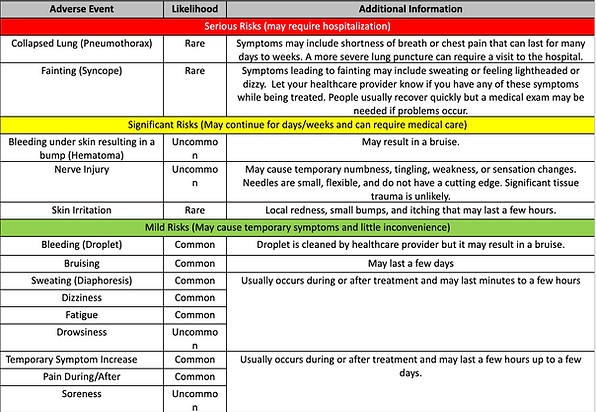
Dry Needling (DN) involves inserting a thin/flexible monofilament needle into symptomatic tissue to reduce pain and improve function. Benefits from DN can be experienced immediately or over a few days to weeks. DN is not Traditional Chinese Acupuncture. DN is based on anatomy, neurology, and physiology. DN has some risks that can occur with the treatment. In the hands of a skilled professional, these risks are small, but you should still be aware of the potential adverse events. The most likely adverse events are listed below by their level of severity (“Serious”, “Significant”, and “Mild”) and how often it may occur (“Common” <10%, “Uncommon” <1%, and “Rare” < 0.1%).
How does it work?
Integrative dry needling is not acupuncture (traditional Chinese medicine), it is based on
neuroanatomy and modern scientific study of the musculoskeletal and neuromuscular systems. A very
fine filament needle is inserted through the skin and into the deeper tissues that have inflammation,
swelling, trigger points that produce pain. Dry needling works by causing a micro lesion within the
pathological tissue improving blood flow, releasing shortened tissues, normalizing the inflammatory
response, and centrally mediating your pain. This mechanical and neuromuscular effect provides an
environment that enhances the body’s ability to rebuild the dysfunctional tissue improving your
function.
What conditions can be treated?
Because of the neurophysiological effects described above dry needling can be effective for
most neuromusculoskeletal conditions. These conditions include, but are not limited to neck, back and
shoulder pain, arm pain (tennis elbow, carpal tunnel, golfer’s elbow), headache to include migraines
and tension- type headaches, jaw pain, buttock pain and leg pain (sciatica, hamstrings strains, calf
tightness/spasms).
Are the needles sterile?
Yes, we only use single use sterile disposable needles.
Is the procedure painful?
The fine filament needle is very thin, solid, and flexible, which allows for the needle to be
inserted through the skin versus cutting the skin. We strive to make the treatment virtually painless,
however we are attempting to create a sensation that is described as an ache, heaviness or
reproduction of the familiar symptom. This is a represents a physiological response that is needed to
reduce your pain. You may also experience a momentary small muscle twitch (contraction) that will
help release your muscle tightness and pain. These sensations are perfectly normal and are desirable
responses. Your clinician closely monitors the process making modifications to the treatment to make
your experience as comfortable and therapeutic as possible.
How will I feel after the Dry Needling treatment?
This will vary but many patients experience immediate relief of their symptoms and an increase
in range of motion. Soreness can also be a common response from the needling but does not occur
with all people. Some individuals may experience an immediate achiness or a delayed soreness that is
reported like a post workout soreness. The soreness, if present, will usually last 1-2 days, use of heat
and light massage and movement will be beneficial. Mild bruising may occur at the needling sites and
is more prevalent in certain parts of the body. Larger bruising may also occur but is rare.
It is uncommon but possible that the treatment may temporarily increase your symptoms. This
is not unusual but if this continues past the 1-2-day window, inform your clinician to allow adjustment
of your program to enhance your comfort the next time.
Will I continue to do exercises or receive other treatments?
Yes, your personalized program will still integrate traditional physical therapy methods
including manual therapy, therapeutic exercise, endurance training, stabilization and posture training.
How many treatments will I need?
This will depend on the category you fit in, which is determined by the state of the injury and
your overall health. Remember we are attempting to cause mechanical and biochemical changes
without any pharmacological means. Therefore, we are looking for a cumulative response to break the
pain cycle. Your clinician will be able to give you more insight after your evaluation.
What should I do to prepare for the treatment?
Do not eat 30 minutes before the treatment
Be well hydrated but empty your bladder prior to treatment
Wear lose fitting clothing, shorts, or swimsuit for easy access to your painful areas
What should/can I do after treatment, what should I avoid?
Recommendations vary depending on the nature of the condition and your individual response
to the treatment. However, common recommendations include increasing your water intake, applying
heat over the area, gentle stretches provided by your clinician and continue with normal daily
activities- movement is good to maximize the benefits of dry needling.
Is Dry Needling treatment covered by my insurance?
Dry needling treatment is billed under specific insurance codes. Your clinician or the
administrative staff will be able to let you know if your insurance covers dry needling.
How does it work?
Integrative dry needling is not acupuncture (traditional Chinese medicine), it is based on neuroanatomy and modern scientific study of the musculoskeletal and neuromuscular systems. A very fine filament needle is inserted through the skin and into the deeper tissues that have inflammation, swelling, trigger points that produce pain. Dry needling works by causing a micro lesion within the pathological tissue improving blood flow, releasing shortened tissues, normalizing the inflammatory response, and centrally mediating your pain. This mechanical and neuromuscular effect provides an environment that enhances the body’s ability to rebuild the dysfunctional tissue improving your function.
What conditions can be treated?
Because of the neurophysiological effects described above dry needling can be effective for most neuromusculoskeletal conditions. These conditions include, but are not limited to neck, back and shoulder pain, arm pain (tennis elbow, carpal tunnel, golfer’s elbow), headache to include migraines and tension- type headaches, jaw pain, buttock pain and leg pain (sciatica, hamstrings strains, calf tightness/spasms).
Are the needles sterile?
Yes, we only use single use sterile disposable needles.
Is the procedure painful?
The fine filament needle is very thin, solid, and flexible, which allows for the needle to be inserted through the skin versus cutting the skin. We strive to make the treatment virtually painless, however we are attempting to create a sensation that is described as an ache, heaviness or reproduction of the familiar symptom. This is a represents a physiological response that is needed to reduce your pain. You may also experience a momentary small muscle twitch (contraction) that will help release your muscle tightness and pain. These sensations are perfectly normal and are desirable responses. Your clinician closely monitors the process making modifications to the treatment to make your experience as comfortable and therapeutic as possible.
How will I feel after the Dry Needling treatment?
This will vary but many patients experience immediate relief of their symptoms and an increase in range of motion. Soreness can also be a common response from the needling but does not occur with all people. Some individuals may experience an immediate achiness or a delayed soreness that is reported like a post workout soreness. The soreness, if present, will usually last 1-2 days, use of heat and light massage and movement will be beneficial. Mild bruising may occur at the needling sites and is more prevalent in certain parts of the body. Larger bruising may also occur but is rare.
It is uncommon but possible that the treatment may temporarily increase your symptoms. This is not unusual but if this continues past the 1-2-day window, inform your clinician to allow adjustment of your program to enhance your comfort the next time.
Will I continue to do exercises or receive other treatments?
Yes, your personalized program will still integrate traditional physical therapy methods including manual therapy, therapeutic exercise, endurance training, stabilization and posture training.
How many treatments will I need?
This will depend on the category you fit in, which is determined by the state of the injury and your overall health. Remember we are attempting to cause mechanical and biochemical changes without any pharmacological means. Therefore, we are looking for a cumulative response to break the pain cycle. Your clinician will be able to give you more insight after your evaluation.
What should I do to prepare for the treatment?
-
Do not eat 30 minutes before the treatment
-
Be well hydrated but empty your bladder prior to treatment
-
Wear lose fitting clothing, shorts, or swimsuit for easy access to your painful areas
What should/can I do after treatment, what should I avoid?
Recommendations vary depending on the nature of the condition and your individual response to the treatment. However, common recommendations include increasing your water intake, applying heat over the area, gentle stretches provided by your clinician and continue with normal daily activities- movement is good to maximize the benefits of dry needling.
